
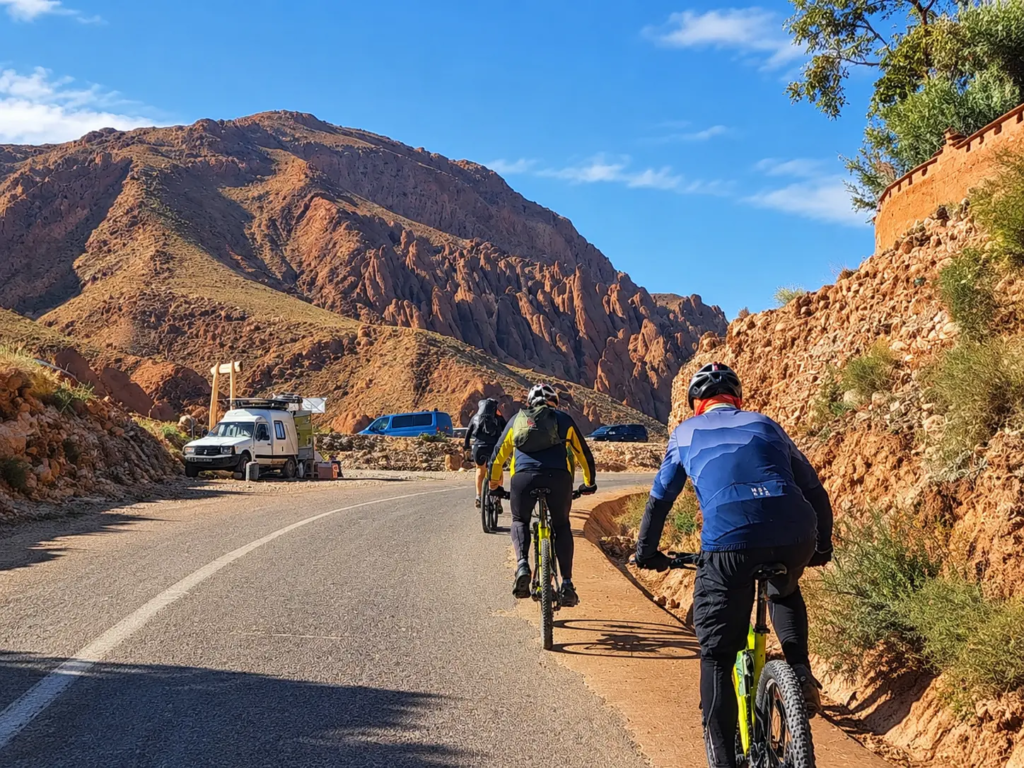
Morocco cycling tours have grown fast, and the reason is simple: few countries pack so much variety into so little distance. In a single week you can climb a High Atlas pass, roll through palm valleys, and finish on desert tracks beside the Sahara dunes. Whether you want guided Morocco bike tours with a support vehicle, a self-guided adventure, or a few days of road cycling in Morocco before a beach finish, this guide covers the best routes, the right season, and the practical details that make a trip run smoothly.
Why Cycle in Morocco
Morocco cycling tours appeal to first-timers and seasoned riders alike, for four main reasons:
- Variety in a short distance: mountains, gorges, oasis valleys, desert edge, and Atlantic coast are all within a few days of Marrakech
- Every riding style: road, gravel, mountain bike, and e-bike trips all run here, so mixed groups can ride together
- A long season: when the high passes are snowy in winter, the south and the coast stay rideable
- Culture at every stop: Amazigh (Berber) villages, kasbahs, and mint tea breaks come with the miles
Road Cycling in Morocco
The High Atlas is the heart of road cycling in Morocco. Long, steady climbs, sweeping descents, and views that change every few kilometers explain why most Morocco bike trips start in Marrakech and head south. These are the best-known routes:
- Tizi n’Tichka (about 2,200 m): the classic climb, often quoted at 2,260 m. Tizi n’Tichka carries the N9 road between Marrakech and Ouarzazate, so the surface is generally good but the traffic includes trucks and buses. Ride early, then continue toward the UNESCO site of Ait Ben Haddou
- Tizi n’Test (about 2,090 m): often praised as one of the best bike roads in the country. It is narrower and quieter, with hairpins, sheer drops at the road edge, and patches of gravel or sand, so it rewards experience and care
- Dades and Todra gorges: road routes cut through towering cliffs and are a highlight of many Atlas-to-Sahara itineraries
- Draa Valley: gentler rides of around 40 to 50 km on palm-lined roads, ideal for easier days after the big climbs
- Marrakech to the Atlantic coast: a popular way to finish a trip, with road and gravel versions that end near Essaouira
Mountain Bike Tours in Morocco
Mountain bike tours in Morocco run on a network of mule tracks, jeep tracks, and singletrack that link villages across the High Atlas. Distances are modest, but the climbing is real, so expect long days at altitude.
- Imlil, Toubkal, and Ourika: classic High Atlas riding within about two hours of Marrakech. Day rides and multi-day crossings, such as Amizmiz to Imlil, run through the foothills around Toubkal, the highest peak in North Africa at 4,167 m
- Oukaimeden: known for enduro descents
- Jebel Saghro and Tafraoute: quieter, rockier riding in the Anti-Atlas. Tafraoute’s almond blossom in late winter makes it a popular choice for early-season rides
- Agafay Desert: gravel loops across stone desert, a short drive from Marrakech
- E-bike routes: pedal assist makes valley tracks and climbs possible for mixed groups and first-time mountain bikers
Morocco Bike Trips by Region
Use this table to match a region to your riding style and the season you plan to travel.
| Region | Best for | Typical terrain | Best months |
|---|---|---|---|
| High Atlas passes | Road climbers | Long climbs, hairpins, big descents | March to May, September to November |
| Toubkal, Imlil, and Ourika | Mountain bikers | Singletrack, mule and jeep tracks | Spring and autumn |
| Anti-Atlas and Jebel Saghro | Quiet gravel and MTB riding | Rocky tracks, almond groves, small villages | October to April |
| Dades, Todra, and Draa Valley | Scenic road riding | Gorge roads, palm valleys | October to April |
| Atlantic coast | Easier days, mild weather | Rolling coastal roads | Most of the year |
Best Time for Morocco Bike Tours
- Spring (March to May): daytime temperatures of roughly 18 to 28°C in most riding regions, high passes that are mostly clear by April, and green valleys
- Autumn (September to November): similar temperatures and clear skies, which makes it the other prime season
- Summer (June to August): valleys and desert-facing roads often pass 35°C, so many operators shorten rides or avoid the hottest valleys
- Winter (December to February): snow and ice can affect the High Atlas passes, while the south and the Atlantic coast stay pleasant. Check conditions with a local guide before crossing a pass
- Ramadan: dates shift every year. Daytime food stops can be limited, and traffic builds in the hour before sunset
Guided or Self-Guided Morocco Bike Tours
Guided tours suit most riders. A typical guided Morocco cycling tour includes:
- A local guide who knows the roads and the weather
- A support vehicle carrying water, food, and spare wheels, which also gives tired riders a lift
- Rental bikes in road, gravel, mountain, or e-bike versions
- Overnight stays in riads, guesthouses, or a desert camp, with your luggage moved for you
Self-guided trips give more freedom but need more preparation. Bike shops are rare outside the big cities, so carry spares and tools, download offline maps, and plan your water and food stops, especially in remote areas.
Choosing the Right Level
Do not choose a trip by the number of days alone. Ask for the daily distance and the meters of climbing, then compare:
- Easy: days of roughly 40 to 50 km on flat or rolling roads
- Challenging road days: climbs of 25 km or more, mostly at 2 to 5% gradients, with steeper ramps near the top of the High Atlas passes
- Mountain biking: days of about 35 to 60 km with 1,000 m or more of climbing are common on Atlas singletrack trips
- Gravel: some routes run 100 km or more in a day
Practical Tips
- Getting there: most trips start in Marrakech (RAK). Agadir (AGA) and Ouarzazate (OZZ) also have airports, though with fewer flights
- Traffic: drivers do not always expect cyclists, and trucks overtaking on narrow roads can be dangerous. Start early and stay visible
- Water: carry 2 to 3 liters on the bike for a full riding day, more in summer, and refill from sealed bottled water
- Sun and layers: wear sunglasses, use sunscreen, and add a cap under your helmet, then pack a light rain jacket and a warm layer for cold mornings on the passes and chilly desert nights
- Bike kit: 32 mm or wider tires suit mixed surfaces, so bring tubes, a pump, and a multi-tool
- Helmet: bring your own, because helmets can be hard to hire locally
- Dogs: occasionally territorial on rural tracks, so stay calm and keep a steady pace
- Dress: keep your legs and shoulders covered in villages and towns when you are off the bike
- Navigation: download offline maps, since the signal can be patchy in remote areas
A Typical Week on Two Wheels
This outline is only an example of a week-long Morocco bike trip. Real itineraries vary by operator, fitness level, and season.
- Day 1: arrive in Marrakech, get your bike fitted, and take a short spin
- Day 2: mountain bike day in the Ourika Valley or around Imlil
- Day 3: road climb of the Tizi n’Tichka and a descent toward Ait Ben Haddou
- Day 4: gorge roads around Dades or Todra, with a transfer where the distances are long
- Day 5: desert tracks near Erg Chebbi, then a camel ride and a night in a desert camp
- Day 6: sunrise over the dunes, then a long transfer back toward Marrakech
- Day 7: a rest morning in the medina and departure
What Does It Cost?
Prices for Morocco cycling tours vary widely. Week-long guided trips are typically priced in the high hundreds to the low thousands of euros per person, depending on the style of riding, group size, support, and accommodation. Before comparing quotes, check what is included: bike hire, meals, airport transfers, luggage transport, and the support vehicle.
Frequently Asked Questions
When is the best time for Morocco cycling tours? Spring (March to May) and autumn (September to November) offer the best mix of mild temperatures and clear mountain roads. Winter works well in the south and on the coast, while summer heat makes most low-altitude routes uncomfortable.
What is the best region for cycling in Morocco? Road riders favor the High Atlas passes, mountain bikers head to the foothills around Imlil and Ourika, and the Draa Valley, Anti-Atlas, and Atlantic coast suit quieter, gentler riding.
Is cycling in Morocco safe? Most riders find the quieter rural roads comfortable, but traffic near cities and on the main passes can be fast and unpredictable. Ride early, stay visible, use a support vehicle on remote roads, and follow your guide’s advice about the passes in bad weather.
Do I need to bring my own bike? No. Many operators offer rental road, gravel, mountain, and e-bikes. If you bring your own, check the airline’s bike fees and pack a spare kit, because repair shops are limited outside the major cities.
How hard are the Atlas passes? Expect long, steady climbs of 25 km or more, mostly at 2 to 5% gradients, with steeper ramps near the top. The Tizi n’Tichka is wider but busier, while the Tizi n’Test is narrower and quieter, with sheer drops and loose gravel in places.
Can beginners join a Morocco bike tour? Yes, if you choose the right route. Look for flat valley and coastal days, or pick an e-bike so the hills stay manageable.
Which airport should I fly into for a Morocco bike tour? Marrakech Menara (RAK) is the usual choice, since most routes start or finish in the city. Agadir (AGA) and Ouarzazate (OZZ) work for coastal or southern starts.
Conclusion
Morocco cycling tours work because the country offers such different rides in one trip: High Atlas passes for road riders, singletrack and mule tracks for mountain bikers, and quiet valleys and desert edges for everyone else. Pick your season first, match the route to your fitness using daily distance and climbing, and ask exactly what a trip includes before you book. With those three decisions made, Morocco on two wheels is one of the most rewarding cycling trips within a short flight of Europe.