About the Sahara Desert

The Sahara Desert, Morocco’s edge of the world

This guide covers everything about the Sahara Desert in Morocco: where it actually is, what a night there is really like, when to go, and how to plan a trip into it. If the dunes are the reason you’re considering Morocco at all, start here.

Overview

The largest hot desert on Earth

The Sahara stretches across nearly all of North Africa, roughly 9 million square kilometers spanning parts of Morocco, Algeria, Tunisia, Libya, Egypt, and several countries further south, making it the largest hot desert in the world (only the polar deserts of Antarctica and the Arctic are bigger). Morocco sits at its northwestern edge, and while the country is mostly mountains and coastline, its slice of the Sahara is exactly what draws most travelers here in the first place.

Contrary to the postcard image, most of the Sahara isn’t rolling sand dunes at all, it’s rocky plateau and gravel plains. The dramatic, photogenic dune fields (called “ergs” in Arabic) are actually a small fraction of the desert’s total area. Morocco’s most accessible and famous erg is Erg Chebbi, near the town of Merzouga, and it’s almost certainly the dunes you’ve seen in photos of a “Morocco desert tour.”

Mediterranean Sea Atlantic Ocean Red Sea SAHARA DESERT MOROCCO WESTERN SAHARA MAURITANIA ALGERIA MALI TUNISIA LIBYA NIGER CHAD EGYPT SUDAN Merzouga / Erg Chebbi Our tours start here Marrakech
At a Glance

The Sahara in Morocco, quickly

Merzouga
Gateway Town
Up to 150m
Erg Chebbi Dune Height
~9 hrs
Drive from Marrakech
0°C – 45°C
Seasonal Temperature Range
Erg Chebbi vs. Erg Chigaga

Not all Sahara dunes are the same

Morocco has two major dune fields open to travelers. Erg Chebbi, near Merzouga, is by far the more accessible: a paved road runs right up to the edge of the dunes, which is why nearly every desert tour, including all of ours, ends up here. The dunes are still enormous, some reaching 150 meters, and the golden color at sunrise and sunset is exactly what you’d picture.

Erg Chigaga, further southwest near M’Hamid, is bigger and more remote, reachable only by 4×4 across open desert with no paved access. It’s a genuinely wilder experience, but it adds a full extra day of driving each way, which is why it tends to suit travelers with more time rather than a first Morocco trip.

Erg Chebbi dunes near Merzouga, Morocco
The Experience

What a night in the desert is actually like

Late Afternoon

Trading your vehicle for a camel

At the edge of Erg Chebbi, the road ends and the camel trek begins. It’s a slower, quieter way to enter the dunes, usually around an hour, and it’s genuinely part of the experience rather than just a way to reach camp.

Sunset

Golden hour on the dunes

The light on Erg Chebbi at sunset is the reason most people come. Many travelers climb the nearest high dune on foot for the view before heading down to camp.

Evening

Dinner and Berber drumming around the fire

Desert camps typically serve a tagine dinner, followed by traditional Berber music around a campfire, drums, singing, and often an invitation to join in.

Night

A genuinely dark sky

With no light pollution for miles, the stars in the Sahara are dramatically brighter than almost anywhere most travelers have seen. Bring a warm layer, desert nights get cold even when the day was hot.

Sunrise

Watching the dunes wake up

Most travelers wake early to catch sunrise from the dunes before riding the camel back to meet the vehicle for the next leg of the trip.

Best Time to Visit

The Sahara by season

March – May

Spring

The best balance: warm days, comfortably cool nights, and clear skies. The most popular season to go for good reason.

June – August

Summer

Genuinely hot, daytime temperatures regularly exceed 40°C. Still doable, especially early morning and evening, but not for everyone.

September – November

Autumn

The other high season, similar conditions to spring: warm days, cool nights, and consistently clear stargazing.

December – February

Winter

Mild, pleasant days but genuinely cold desert nights, sometimes near freezing. A warm sleeping layer is essential.

Nomadic Life & Landscape

The people who call the desert home

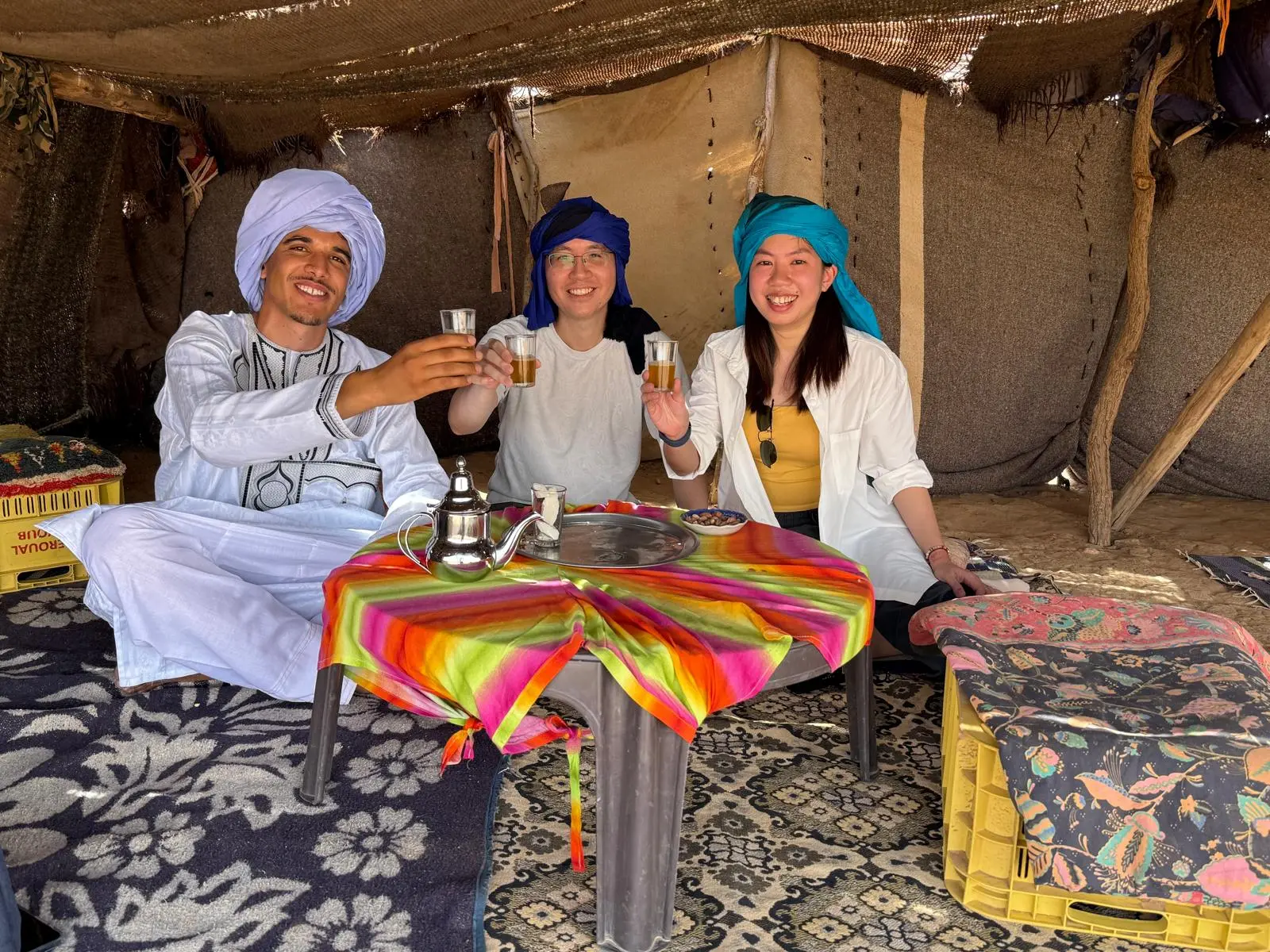
Berber and nomadic families have lived alongside the Sahara for generations, and many desert tours, including ours, include a stop to meet a local family and share mint tea. It’s usually the most memorable stop of the whole trip for travelers, a genuine glimpse into a way of life shaped entirely by the desert.

Around Merzouga, you’ll also find Khamlia, a village known for Gnawa music, a rhythmic, spiritual musical tradition brought by sub-Saharan communities generations ago. Small oases, date palm groves, and ancient underground water channels called khettaras dot the region, evidence of how people have made the desert livable for centuries.

Visiting a nomad family in the Sahara Desert, Morocco
Practical Info

Good to know before you go

What to Pack

Layers are essential, hot days, cold nights. A warm fleece, a scarf for sand and sun, sunglasses, and sturdy shoes for the dunes.

Camp Facilities

Comfort-tier camps use clean, shared bathrooms; Superior and Luxury tiers include a private en-suite tent with a hot shower.

Tipping

Tipping camp staff and your camel guide is customary if you’re happy with the experience, small bills are appreciated.

Luggage

Your main bag stays locked in the vehicle. Pack a small overnight bag for the desert camp itself.

Common Questions

About the Sahara Desert: quick answers

Where exactly is the Sahara Desert in Morocco?

Morocco’s main accessible dune field, Erg Chebbi, is near the town of Merzouga in the southeast of the country, close to the Algerian border. It’s typically reached by road from Marrakech, Fes, or Errachidia.

Is the camel trek difficult?

Not really. It’s a gentle ride, usually around an hour, though the swaying motion takes a few minutes to get used to. If you’d rather not ride, a 4×4 transfer to camp can usually be arranged instead.

How cold does it actually get in the desert at night?

It varies a lot by season. In summer, nights stay mild. In winter, temperatures can drop close to freezing, a genuine surprise for travelers who only picture the desert as hot. Pack a warm layer regardless of when you go.

Are there toilets and showers in the desert camp?

Yes. Comfort-tier camps use clean, shared facilities; Superior and Luxury tiers include a private en-suite tent with a working toilet and hot shower.

How many nights should I spend in the desert?

One night gives you the sunset, campfire, and sunrise experience. Two nights adds a full day for 4×4 dune exploration, a nomad family visit, and more time to simply be there, which many travelers say they wish they’d booked.

Ready to see the Sahara for yourself?

Browse our desert tours, or message us your dates and we’ll help you plan the right route into Erg Chebbi.

Scroll to Top