
A country of deserts, mountains, and imperial cities
This guide covers everything you need to know about Morocco before you go: its regions, its seasons, its culture, and the practical details that make planning a trip here easier. From the golden dunes of the Sahara to the snow-capped peaks of the Atlas and the blue-washed streets of the north, Morocco packs an extraordinary range of landscapes into one country.
What makes Morocco different
Morocco sits at the northwest corner of Africa, a short ferry ride from Spain but a world away in feel. It’s one of the few countries where you can wake up to the call to prayer in a centuries-old medina, drive through snow-dusted mountain passes by lunch, and watch the sun set over Sahara dunes the same evening. That range is really the whole story of Morocco: a place shaped by Berber (Amazigh) roots, Arab and Islamic history, decades of French and Spanish colonial influence, and its position as a genuine crossroads between Africa, Europe, and the Middle East.
For travelers, that translates into a country you can experience in very different ways depending on where you go and what you’re after, imperial cities dense with history, the vast openness of the Sahara, mountain villages that have barely changed in generations, and a coastline that swings between laid-back surf towns and modern port cities. Most first-time visitors combine at least two or three of these into one trip, which is exactly how most of our tours are built.
Morocco, quickly
Four landscapes, one country
Morocco’s geography is unusually varied for a single country. Along the Atlantic and Mediterranean coasts, you’ll find fertile plains and the country’s biggest cities, including Casablanca and Rabat. Moving inland, the Atlas Mountains cut diagonally across the country in three ranges, the High, Middle, and Anti-Atlas, reaching over 4,000 meters at their peak near Toubkal, and separating the coastal north from the pre-Sahara south. East and south of the Atlas, the landscape turns to arid plateau and eventually the Sahara Desert proper, where Erg Chebbi’s dunes near Merzouga are the classic image most travelers picture when they think of Morocco.
That geography is also why so many Morocco itineraries follow a similar shape: starting in a coastal or imperial city, crossing the Atlas via one of its mountain passes, and ending in or near the desert. It’s a genuinely dramatic transition to experience in a matter of days, snow-capped peaks in the morning, palm oases and dunes by evening.
Six very different Moroccos

The Sahara Desert
Erg Chebbi’s towering dunes, camel treks, and nights under a truly dark sky.
See desert tours →
Marrakech & the South
Souks, palaces, and the Red City’s endless energy at the foot of the Atlas.
See tours from Marrakech →
The Atlas Mountains
Berber villages, dramatic passes, and trekking routes through the High and Middle Atlas.
See mountain tours →
Fes & the Imperial Cities
The world’s oldest continuously inhabited medieval city, tanneries, and centuries of history.
See tours to Fes →
Chefchaouen & the North
The famous Blue City, tucked into the Rif Mountains near the Mediterranean.
Read our Chefchaouen guide →
The Atlantic Coast
Casablanca’s modern skyline and the Hassan II Mosque, right on the ocean.
Read our Casablanca guide →Morocco by season
Spring
Widely considered the best season: mild temperatures everywhere, wildflowers in the valleys, comfortable desert days.
Summer
Hot, especially in the Sahara and Marrakech. Better suited to the coast and mountains than a desert trek.
Autumn
The other high season: warm days, cooler nights, and the same comfortable conditions as spring.
Winter
Mild by day in most of the country, but genuinely cold at night in the desert and snowy in the High Atlas.
A blend of Arab, Berber, and African heritage
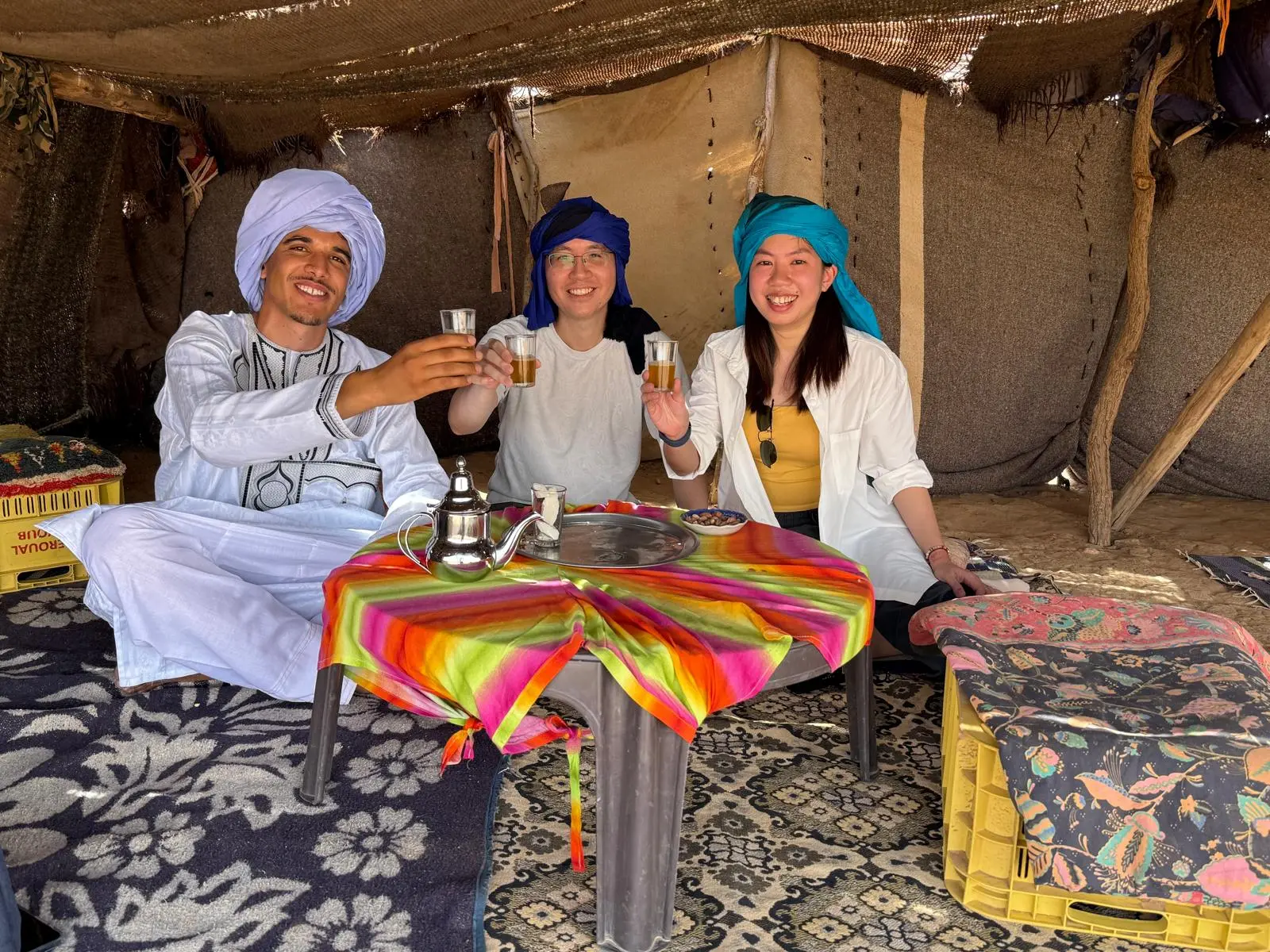
Morocco’s culture is shaped by its Berber (Amazigh) roots, centuries of Arab influence, and its position as a crossroads between Africa, Europe, and the Middle East. That mix shows up everywhere, in the architecture of the medinas, the rhythms of Gnawa music, the ritual of mint tea, and the warmth of Berber hospitality that travelers consistently mention as the highlight of their trip.
Islam shapes daily life across the country, and modest dress (covering shoulders and knees) is appreciated when visiting mosques, medinas, and smaller towns. Outside of that, Morocco is a genuinely welcoming, easygoing country for travelers of all backgrounds.
From Berber kingdoms to modern Morocco
Morocco’s story begins with the Amazigh (Berber) peoples, who have inhabited North Africa for thousands of years and remain a core part of the country’s identity today. Arab dynasties arrived starting in the 7th century, bringing Islam and founding cities like Fes, which became major centers of learning, trade, and religion across the medieval Islamic world.
In the early 20th century, Morocco became a French and Spanish protectorate, a period that left a visible mark on the country’s architecture, cuisine, and language, French is still widely spoken today. Morocco regained independence in 1956 and has been a kingdom ever since, one of the more politically stable countries in the region.
What you’ll actually be eating
Moroccan food is one of the most memorable parts of any trip. Tagine, slow-cooked stews of meat or vegetables named after the clay pot they’re cooked in, and couscous, traditionally served on Fridays, are the two dishes you’ll encounter most. Expect a lot of warm spices (cumin, cinnamon, saffron, preserved lemon) rather than heavy heat.
Mint tea, poured from height in a small ceremony, is less a drink and more a social ritual, you’ll be offered it constantly, and it’s genuinely rude to refuse. Street food is generally excellent and safe if the stall is busy with locals; Marrakech’s Jemaa el-Fna food stalls at night are a rite of passage for most first-time visitors.
Good to know before you go
Currency & Payments
The Moroccan Dirham (MAD) is the local currency. ATMs are common in cities; carry cash for rural stops and small vendors.
Language
Arabic and Berber are official; French is widely spoken, and English is common in tourist areas and with our guides.
Visas
Requirements vary by nationality and can change. Check your country’s current entry requirements before booking.
Safety
Morocco is safe for the vast majority of travelers. Read our full guide: Is Morocco Safe?
About Morocco: quick answers
Is Morocco safe to visit?
Yes, for the vast majority of travelers. Read our full breakdown, including common scams and solo travel tips, in Is Morocco Safe?
What language do they speak in Morocco?
Arabic and Berber (Amazigh) are the official languages. French is widely spoken as a result of the colonial period, and English is common in tourist areas, hotels, and with local guides.
How many days do I need in Morocco?
It depends on what you want to see. A 3-day trip covers a Sahara Express-style loop from Marrakech; 7 to 10 days lets you combine the desert, the Atlas Mountains, and one or two imperial cities without feeling rushed.
Do I need a visa to visit Morocco?
Requirements vary by nationality and can change, so check your country’s current entry requirements before booking your trip.
What’s the best way to see the Sahara Desert?
Almost all Sahara trips route through Merzouga and the Erg Chebbi dunes, typically combined with a camel trek and a night in a desert camp. See our desert tours for the full range of options.
Ready to see it for yourself?
Browse our tours, or message us your dates and we’ll help you build the right route through Morocco.